
The Road Within the Road
What five thousand miles taught me about presence, attention, and the difference between moving and changing

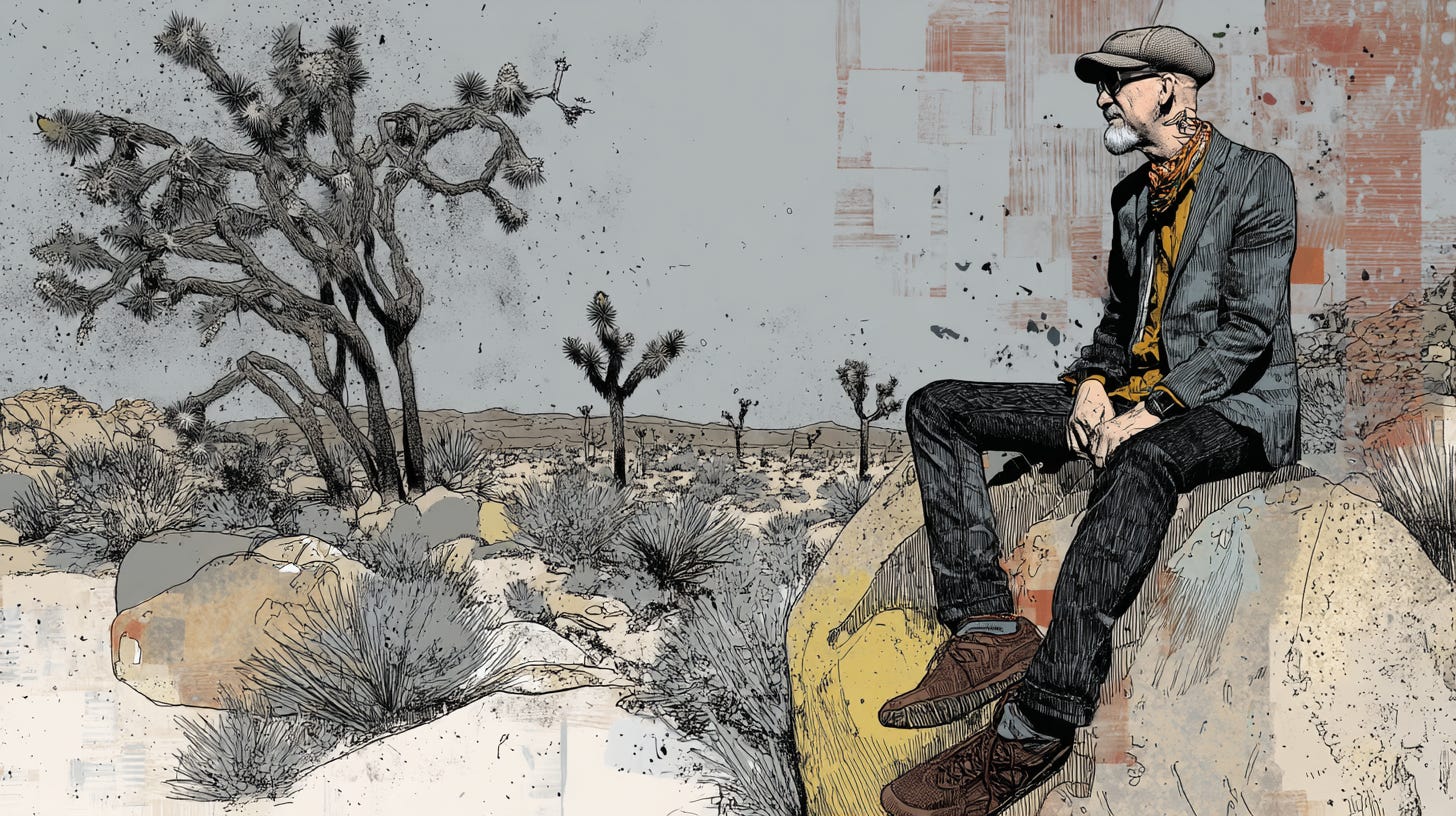
I’ve noticed in my 67 (soon to be 68!) years on this planet that you can walk for a long time and still never arrive anywhere new. Not on the outside, anyway.
As we close out this five-part attempt to tell the truth about a physical road and the quieter one running inside it, I keep coming back to the road made of memory and identity, of fear and grief, of desire and possibility - the one you can’t photograph, can’t map, can’t always explain, yet somehow it’s the road that changes you.
Somewhere along the way, I felt the creative studio’s subcontext start to overshadow the pilgrimage itself. Not loudly, more like a helpful assistant who slowly starts answering your emails, then rearranging the furniture, and one morning you realize you’re living inside its system. A moment of tenderness becomes a paragraph before it fully becomes a memory. A sunset becomes a line break. And I don’t say that with contempt - this is what creators do, we translate life into language, and sometimes that’s how we make meaning.
But there’s a danger in it too. Documenting the journey starts out as a way of honoring it, and slowly becomes a way to control it, then a way to avoid it, because recording is safer than being changed. If I can write the moment down, I don’t have to let it rearrange me.
That’s where the road within the road starts asking its real questions - not how far did you go, but what did you let touch you. Not what did you see, but what did you finally stop pretending you couldn’t see.
There were days when I confused the practice of “discovery hiking” with the quieter practice of changing. But movement, on its own, can be a kind of hiding - you can cover an impressive number of miles and keep the same inner furniture arranged the same way, just in different weather. Transformation costs more than motion. It asks for surrender, for honesty, for you to stop bargaining with reality.
The question always in my head is, “Who do I become by walking this mountain path, or driving this forest service road into the unknown? Who am I at the end?”
Technology isn’t the villain here, and I’m not interested in a sermon about phones or AI. But it is an attention machine, and attention isn’t neutral - what we point it toward becomes, over time, our life. So the question isn’t whether to use technology, it’s who’s holding the wheel when I do. On the road, I noticed how easily I could be standing inside an experience and already halfway outside it, translating it into something shareable. So I made a small vow. There are moments I won’t record. Moments I’ll let be unproductive. Moments that don’t need to become anything else.
I don’t know if you’ve felt this too, the way the urge to capture can be the urge to control, the way staying present can feel like a risk. And being with it, concretely, means being with the grief when it rises, the fear when it tightens your chest, the desire you keep downplaying. That’s the invisible road, and it doesn’t care how many miles you logged. It cares what changed.
Which brings me to the hardest question of the series: what must change after the insight? Because insight is a door handle, not a finish line - and if nothing changes afterward, it becomes just another kind of content, admired and filed away while your life stays the same. I didn’t take this journey, or write this series, for a neat ending tied up with a bow.
If anything, I think later life is unfinished work - and not in a depressing way, in a relieving way. It means you’re not late, not disqualified, and you can still become someone new. Maybe that’s the deeper gift of the road: it shows you, in your body, that your identity isn’t as fixed as your fear wants you to believe.
So what am I carrying out of this journey? A few simple things, simple but not easy:
Being more careful about what I turn into material, because presence is sacred
Noticing when I’m confusing movement with transformation
Treating attention as something to offer on purpose, not spend mindlessly
Letting the road keep working on me after the walking is done
Because the real pilgrimage ends when you start living differently.
If you’ve read all five parts, thank you. Being read is its own kind of companionship. Maybe the next step isn’t a grand gesture, just a small, quiet choice you make more than once: to be here, to stay honest, to let a moment be a moment instead of raw material for something else. That’s the road within the road. And unlike the miles behind you, it’s still open.
How about you?
Jeff